

An Explanation
About the R&D Tax Credit
Introduction
The R&D tax credit has been one of the most valuable tax breaks available to American companies for decades. Established in 1981 to increase investment in U.S.-based innovation, it now provides billions of dollars in tax savings annually to companies across the country — and businesses that claim it still benefit from the normal tax deduction for their R&D expenses on top of the credit.
Despite its size, the credit is widely underused. Many small companies don't realize it applies to them — they assume it's reserved for large corporations with formal research departments. Others assume it's limited to technology and manufacturing, when in reality companies across a wide range of industries qualify. That gap between who's eligible and who claims it is exactly where Firestone comes in.
The federal credit generally amounts to 5–10% of R&D expenses, and many states offer an additional 3–15%. It can be claimed for the current year and for up to three years in the past, and can reduce payroll taxes for certain pre-revenue startups.
How the R&D Tax Credit works
1. Qualified research activities
To be eligible, a company must spend money attempting to create a new or improved product, software, production process, technique, or design (including building systems or structural designs).
2. Qualified expenses
Four categories of spend can be included in the credit calculation:
Wages paid to U.S. employees involved in design, prototyping, testing, etc.
Payments to U.S. contractors or vendors providing R&D services
Materials used during these activities
Payments for cloud-based development environments or cloud-computing development resources
3. Documentation
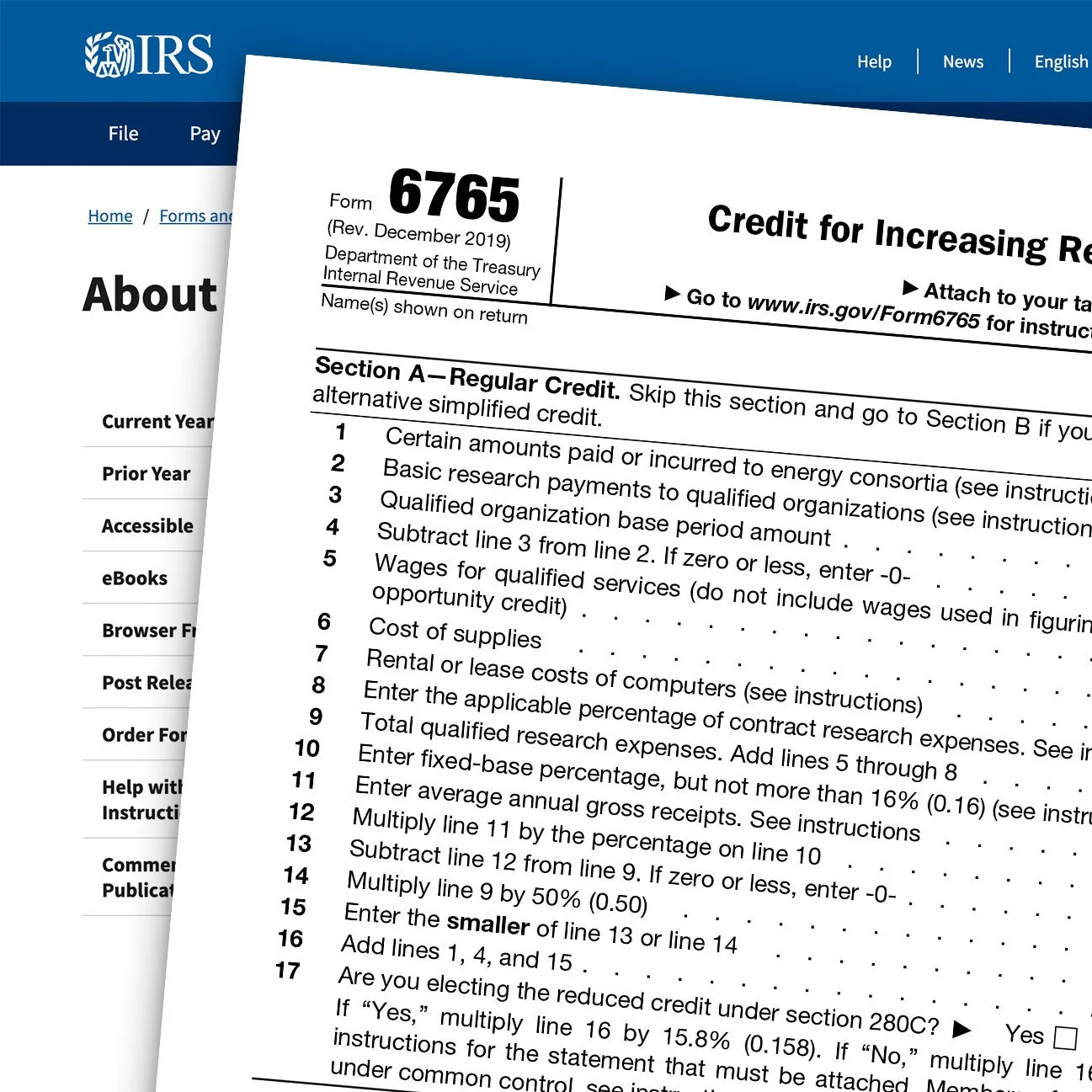
Claiming the credit starts with gathering R&D expense records that support the qualifying activities. The credit is calculated and claimed on the company's tax return, and supporting documentation is compiled to back the claim if it's ever reviewed.
How much could the R&D tax credit save you?
R&D Tax Credit Calculator

Does your company qualify?
This process begins by gathering R&D expense information and records that support the R&D activities that have taken place. The tax credit amount is then calculated, and the credit itself is claimed via the company’s tax return. After the credit is claimed, records and documentation are gathered to support the tax credit. This is where Firestone comes in — we specialize in partnering with companies to calculate, claim, and support federal and state R&D tax credits. After one short introductory conversation, we will have a good idea of whether your business could benefit from the R&D tax credit. If your business is eligible, we are committed to helping you claim the maximum amount that you deserve.
Industries that Benefit
There is no requirement that companies be part of specific industries to claim the R&D tax credit — it is available to any company regardless of industry that performs qualified activities. The following industries and activities are likely to be eligible.
-

Software & Technology
Development of software, apps, data handling, memory optimization, processing engines, algorithms, APIs, database technologies, firmware, robotics, new technologies, automated systems, robotics, etc.
-

Manufacturing
Design of new or improved products, custom products, tools, molds, jigs, fixtures, etc. Development or optimization of CNC programs and equipment operations and toolpaths. Developing new manufacturing processes or capabilities; improving existing manufacturing lines or processes.
-

Precision Machining
Design of new or improved parts, custom parts, fixtures, jigs. Development or optimization of CNC programs and equipment operations and toolpaths. Development of new machining capabilities or improved processes.
-

Engineering
Creating HVAC, mechanical, structural, civil, environmental or other designs. Product development, 3D modeling, testing, etc.
-

Electronics Design & Production
Design of printed circuit boards and integrated circuits, developing circuit board production process (pick & place, through hole, etc.), first article runs, development of mechanical and case components for electronics, etc.
-

Foundries & Molding
Design of molds, dies, stamps, and tools, developing part-specific molding processes, material application development, injection time analysis, gate seal analysis, cavity balance study, first article test runs, etc.
-

Architectural
Developing energy-efficient features, schematic designs, technical building systems design, building envelope design, etc.
-

Construction
Building systems design, structural engineering, site engineering, structural and miscellaneous steel detailing and fabrication, design-build projects, etc.
-

Life Sciences
Formulations development, pharmaceuticals development, development of seed varieties, coatings, treatments, etc.
-

Food & Beverage
Formulation and recipe development, nutrition profile development, shelf-life and stability testing, production process development, etc.
-

Retail & Distribution
Developing sales, inventory, or supply-chain applications, processing automation, etc.
-

Financial
Development of client portals, quote-generation engines, servicing and delivery applications, and more in the insurance, banking, investing, and other financial areas.
-

Service Providers
Development of client portals, quote-generation engines, servicing and delivery applications, and more in the insurance, banking, investing, and other financial areas.
-

Miscellaneous
Regardless of industry, any company that has invested into custom software, had mobile applications developed, invested in automation, etc.
How Firestone Helps
Identify opportunities: an initial conversation to surface likely-qualifying activities
Analyze activities: a closer look at what the business is doing, against the qualifying criteria
Calculate the credit: determining the federal and state credit amount based on qualified expenses
Prepare documentation: compiling records that support the claim, so it's ready if reviewed
After one short introductory conversation, Firestone will have a good idea of whether your business could benefit. If eligible, Firestone is committed to helping you claim the maximum amount you deserve.
View the full step-by-step process →
Working With Your CPA
Many eligible companies overlook the R&D tax credit because qualifying activities happen throughout the business, not just in a formal research department. Firestone works alongside CPAs to identify opportunities, complete technical documentation, and help clients maximize the credits available to them.
That partnership is real, not just a talking point: Zach Boyd, CPA and founder of Boyd CPA, has partnered with Firestone since 2017, referring clients for both R&D tax credit and cost segregation work. "Many CPAs are looking for ways to offer more strategic value to their clients," Zach says. "Partnering with Firestone is one of the best ways to do that, and Rance has never once tried to pull a client away from my practice."
See how one referral led to $60,000 in tax savings →
Partnering with Firestone means you can:
Offer specialized R&D tax credit and cost segregation services without building that expertise in-house
Avoid losing complex clients to larger firms
Deepen your value to clients without adding to your workload
Focus on tax prep while Firestone handles the technical study